How it began
Angus becomes Angus, Part One.

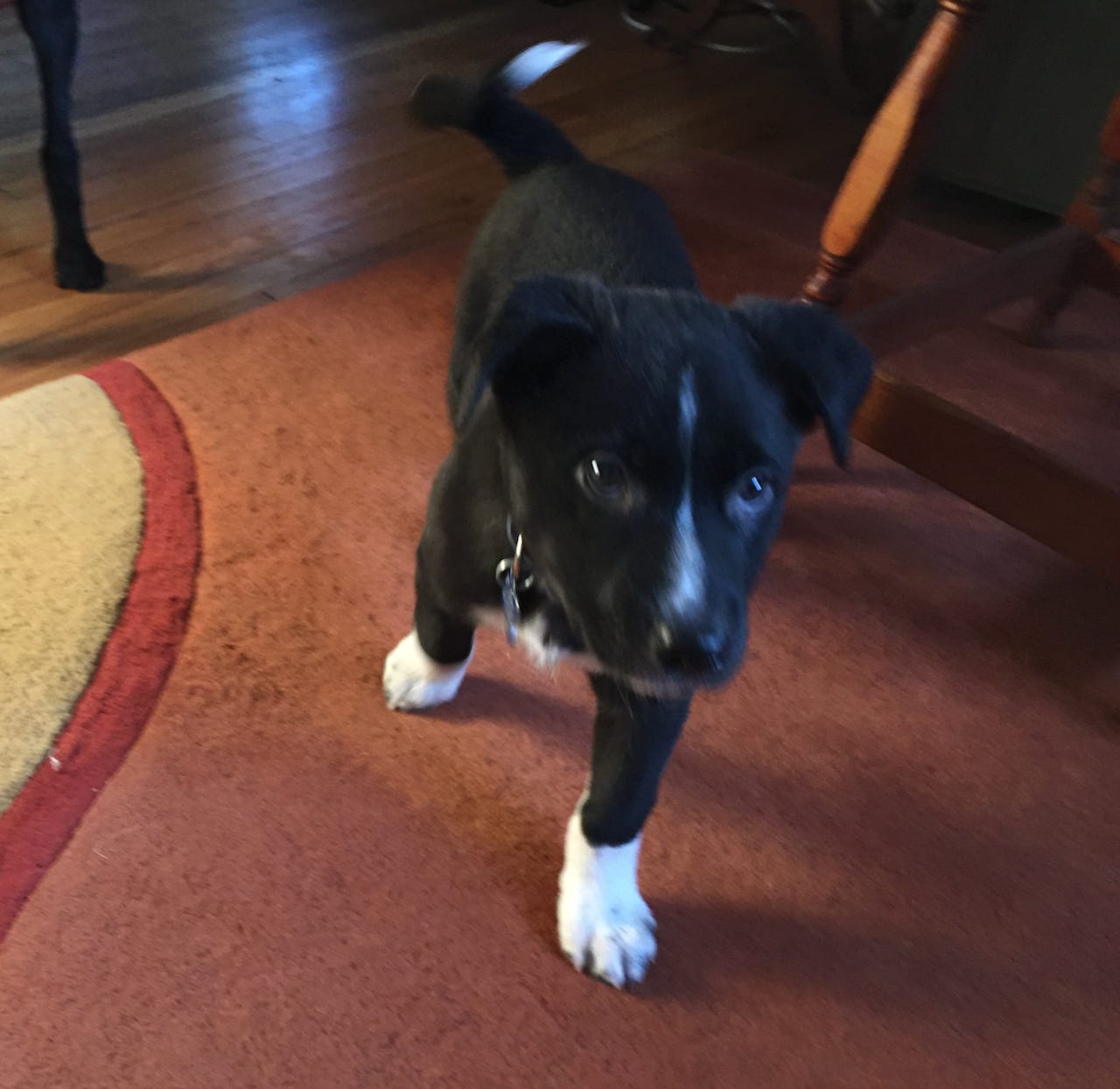
Back in the day, he was just a puppy. Not a complicated, fearful dog. Just an adorable puppy with huge white feet, open to the world.
We are home from the North and my god it is cold. A stiff wind and what they call “chilly sunshine” but what I call out-and-out frigid. Apparently it was snowing up the Shore yesterday morning; at the cabin near Hinckley there was no snow but it was 29 degrees when I walked Angus to the beaver pond before breakfast. Back in St. Paul, it was not much warmer. I stood outside chatting with our neighbor until I thought my hands were going to freeze.
Angus is back to his overwrought ways — wouldn’t eat breakfast, wouldn’t eat dinner. Jumps up at the slightest noise and runs out of the room. This trip was just too much for him, too many different cabins, too many times when he was stuffed into the car crate and driven for hours. He simply can’t cope.
It will take days for him to calm down and get back to normal, whatever normal is for such a highly reactive dog.
“Advocate for your dog,” the vet behaviorist tells me, but does that mean we should never go on vacation? Never disrupt the routine? I hate seeing Angus so traumatized but there are times when I get frustrated and want to yell—everything traumatizes him. Everything. Can’t I ever put myself first? Can’t he ever be the one to compromise? (Of course not, silly. He’s a dog.) (And yelling doesn’t help. It just upsets him even more.)
Angus wasn’t always like this. And before you ask, no, it’s not our fault he’s this way. It’s not because of something we did or didn’t do. It’s genetic.
We adopted Angus at the very end of December in 2017 and had about two and a half months of him being an ordinary, roly-poly, goofy puppy — one who occasionally peed in the house and gnawed the leg on our living room table and tried to bite my toes and eat rocks because he didn’t know they weren’t food. He bounced at the side of the bed in the mornings until I hauled him up by the scruff of his neck, and then he settled down and cuddled and absent-mindedly chewed my hair.
Every day after breakfast, I’d click his chest harness onto him, open the front door into the cold January or February or March morning, and we would walk. He sniffled and snuffled—he was fascinated by footprints left on snowy sidewalks and spent a lot of time examining each one carefully with his snout. He pounced on dead leaves, he zigzagged back and forth across the sidewalk in front of me, and sometimes behind me, and I worried about tripping over him or, worse, crushing him with my big snowbooted foot.
It is weird to look back on the notes I took during that time. He was such a … normal puppy! So ordinary! Sweet and funny and loving everyone and everything. The world was new and it was his oyster and it was to be embraced.
“He is trusting and loves others,” I wrote in mid-January, when we had had him for about two weeks. “He met another couple of neighbors yesterday, and the night before he met a neighbor with a big shaggy dog, and he hopped around and sat nicely and was delighted. This is pretty normal for puppies; it is only when they get a little older that they start feeling a natural wariness of others. So we must continue to socialize him and have him meet people as much and as often as possible--not as easy in the winter, but we are doing our best. (Neighbors, if you read this, come meet Angus!)”
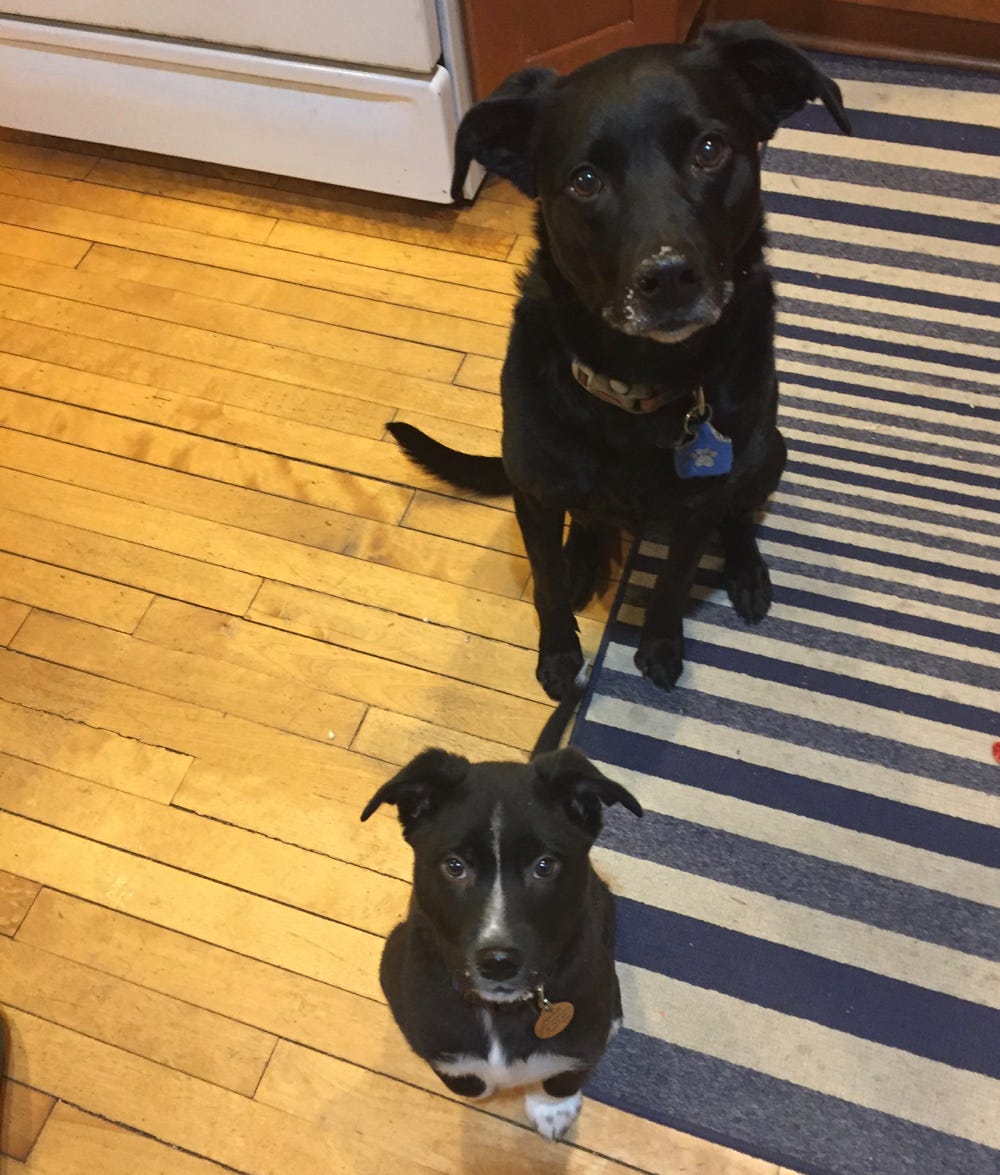
Soulful Rosie and fat little Angus, early 2018
Ah, yes, neighbors, come meet Angus! This was a great idea until mid-March of 2018 when, one morning, I clicked the harness onto Angus, opened the front door to the frigid morning, walked outside, and Angus began to bark.
A few people were standing at the bus stop across the street from our house—as they were every morning—and Angus’s barks were aimed at them. My first reaction was embarrassment. My second, immediately following, was confusion. Those people were there every morning. Why was he barking at them now?
I wasn’t sure if I should correct him, reassure him, distract him, make him sit, make him walk, take him home—what was the right thing to do? Why was he barking? What was he feeling—anger? fear? surprise? While I dithered, Angus continued to bark. I made him sit, made him look at me, and when he did, I gave him a treat. He ate the treat, leaped up, and began barking again. Hey! That’s not how it’s supposed to work! The treat is supposed to be a reward for sitting quietly and looking at me. He’s not supposed to just gobble it down and bark some more. But that is what he did.
All I could do was drag him away. But it wasn’t those few bus riders he was afraid of; it was, suddenly, everyone. A few blocks ahead of us, someone was scraping frost off a car windshield. The scritch-scritch-scritch of the scraper seemed to enflame Angus. He barked again, a volley of barks. For such a little guy—he was still less than 20 pounds — he had a ferocious bark. It might have been the early morning hour that made me uncomfortable—how many people is he disturbing? Or it might have been the weirdness of it all—why is he suddenly barking at everyone? I tried to stay calm and in control— Sit! Watch me! Good boy!—but inside I was panicking. And I was a little bit afraid.
Was this just a bad day? Or was this the beginning of a whole new Angus? I had a feeling I knew which one it was. Which meant a whole new life for me.
I’ve had my 3-year-old rescue for 6 months now. I now believe there is some sort of “little dog” syndrome. The vet’s office calls him “spicy” a nice way of saying, “Please put a muzzle on your dog.” It’s partially fear, anxiety, and a one-person-dog mindset that creates the issue (my theory). And yes, it’s very constraining on a person’s life.
Our rescue puppy was fearful from the day we adopted him. He was 4 months old, came up from Alabama, and clearly missed out on that important early socialization. He glommed onto me but feared going for walks with my husband. We wound up putting him in a 21-day board and train program, which helped immensely. Still, he’s afraid of strangers and some dogs, baths, going to the vet, etc.